
Comparing Drive Mechanisms for Maryland Garages
Which garage door opener is best for your home depends on a few key factors: your garage’s location relative to living spaces, your door’s size and weight, and how much you value smart features like app control and battery backup. Here’s a quick breakdown to help you decide fast:
| Your Situation | Best Opener Type | Why |
|---|---|---|
| Garage attached to living space or bedroom | Belt drive | Quietest operation (~60 dB), minimal vibration |
| Detached garage, heavy door | Chain drive | Affordable, durable, handles more weight |
| Limited ceiling space or high ceilings | Wall-mount (jackshaft) | Frees up overhead space entirely |
| Extreme temperatures or one-piece door | Screw drive | Fewer parts, fast operation |
| Want smartphone control and monitoring | Smart opener (any drive) | Wi-Fi, app control, camera, battery backup |
Quick horsepower guide:
- 1/2 HP – Standard aluminum or single steel doors
- 3/4 HP – Insulated steel or heavier double doors
- 1 HP+ – Solid wood, oversized, or heavily insulated doors
For most Maryland homeowners with an attached garage, a belt-drive opener with Wi-Fi and battery backup hits the sweet spot of quiet performance, convenience, and security.
If you’ve ever been halfway to work and wondered, “Did I actually close the garage door?” — you’re not alone. It’s one of the most common frustrations homeowners mention when thinking about upgrading their opener. Modern garage door openers in 2026 have come a long way from the rattling, chain-clanking machines many of us grew up with. Today’s models offer smartphone control, built-in cameras, auto-close scheduling, and backup power for outages — features that genuinely change how you interact with your home every day.
But with so many options on the market — belt drives, chain drives, jackshaft openers, smart hubs — it’s easy to feel overwhelmed. The right choice depends on your specific garage setup, your door’s weight and size, and how you actually use your garage. This guide breaks it all down so you can make a confident decision.
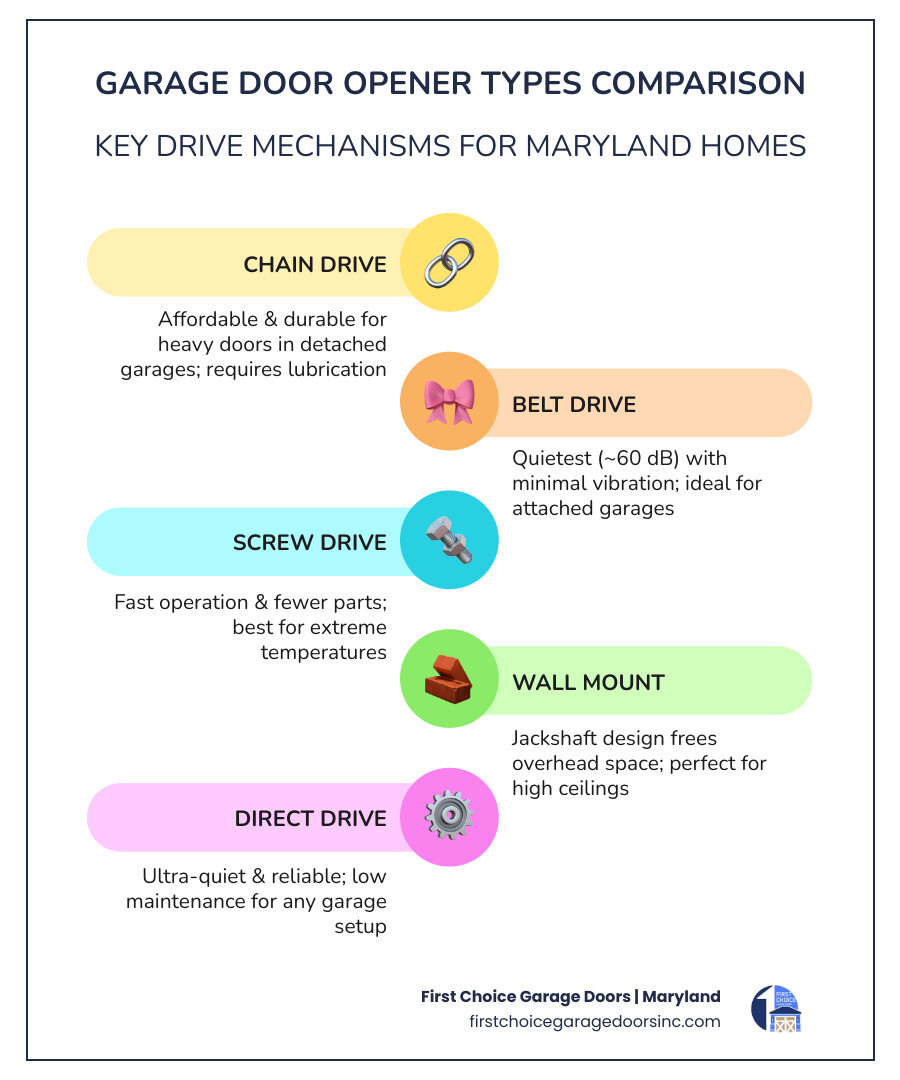
When we look at 3 Types of Garage Door Openers, it’s clear that the “best” model is entirely subjective. The drive mechanism is the part of the opener that actually moves the trolley along the rail to lift your door. In 2026, the technology has reached a point where even budget-friendly models are incredibly reliable, but the experience of using them varies wildly in terms of noise and speed.
| Drive Type | Noise Level | Durability | Best For |
|---|---|---|---|
| Chain Drive | High (70+ dB) | Very High | Detached garages, heavy doors |
| Belt Drive | Low (~60 dB) | High | Attached garages, bedrooms above |
| Screw Drive | Moderate | Moderate | One-piece doors, fast operation |
| Wall Mount | Ultra-Low | Very High | High ceilings, storage needs |
Understanding the Chain Drive vs Belt Drive Garage Door Opener Comparison is the first step for most homeowners in Columbia or Easton. While both are dependable, they serve very different lifestyles.
Which garage door opener is best for your home if you need quiet operation?
If your garage is located directly beneath a bedroom or adjacent to a living room, noise reduction isn’t just a luxury—it’s a necessity for your peace of mind. For these “noise-sensitive” homes, we almost always recommend Product_Categories/Belt Drive/ openers.
Belt drives use a steel-reinforced rubber belt instead of a metal chain. This eliminates the “clanking” sound and significantly reduces vibration. Modern belt drives operate at roughly 60 decibels, which is about the volume of a normal conversation. When paired with vibration-dampening mounts, these openers allow family members to sleep undisturbed even if someone arrives home late at night.
Durability and maintenance for detached garages
For homes with detached garages where noise isn’t an issue, Product_Categories/Chain Drive/ models are the gold standard for value and strength. These systems use a metal chain similar to a bicycle chain to pull the door.
Chain drives are incredibly durable and typically handle heavier doors with ease. However, they do require a bit more attention. To keep them running smoothly, you’ll want to perform regular lubrication of the chain and sprockets. While they are noisier, they are often more affordable upfront and are built to withstand the test of time in Maryland’s humid summers and chilly winters.
Selecting Horsepower Based on Door Material and Weight
Horsepower (HP) is the measure of the motor’s lifting capacity. A common mistake is choosing an underpowered motor to save money, which leads to premature motor failure and safety risks. When Picking the Best Garage Door Opener for Your Home, you must match the HP to the weight and material of your door.
- 1/2 HP: This is the standard for most residential aluminum doors or single-car steel doors. It’s plenty of power for a door weighing up to 350 pounds.
- 3/4 HP: We recommend this for heavily insulated doors, wind-load rated doors, or double-car garage doors. It provides extra “muscle” to reduce strain on the motor.
- 1-1/4 HP and above: This is essential for solid wood doors or oversized carriage-house styles that can weigh over 500 pounds.
Your garage door is spring-balanced. The opener is designed to overcome friction and inertia, not lift the entire dead weight of the door. However, having that extra power ensures longevity. You can find more details on Factors to Consider When Selecting Your Garage Door Opener to ensure you don’t over- or under-buy.
Determining which garage door opener is best for your home based on door size
Size matters just as much as weight. While standard sectional doors are 7 feet tall, many modern Maryland homes feature 8-foot doors to accommodate SUVs and trucks. Most openers come with rails for 7-foot doors, so you may need an extension kit.
Using an underpowered opener on an oversized or one-piece door can cause the motor to “struggle,” leading to a jerky motion that damages the door’s hardware. Making Sure You Select the Perfect Garage Door Opener means verifying that the rail length and motor capacity match your specific dimensions.
AC vs DC motors in 2026
In 2026, the shift toward DC (Direct Current) motors is nearly complete. Unlike the “AC monsters” of the past that hummed and vibrated, DC motors are smaller, lighter, and much quieter.
One of the Garage Door Opener Features You’ll Want to Have is “soft start/stop” technology, which is exclusive to DC motors. This feature allows the door to begin moving slowly, accelerate to full speed, and then slow down before touching the floor. This reduces the “bang” at the end of the cycle and extends the life of your door’s hinges and rollers. DC motors often use HP-comparable (HPS or HPc) ratings rather than true mechanical horsepower.
Essential Smart Features and Safety Tech for 2026
Smart Garage Door Openers have transitioned from “cool gadgets” to essential home security tools. In Maryland, where we often deal with unpredictable weather and busy commutes, being able to check your door status from your phone is a game-changer.
The myQ app and Genie’s Aladdin Connect are the two dominant platforms. These apps allow you to:
- Receive real-time alerts if the door is left open.
- Close the door remotely from anywhere in the world.
- Set schedules (e.g., “Close the garage every night at 10:00 PM”).
- Integrate with Amazon Key for secure in-garage package deliveries.
Beyond the app, many 2026 models feature integrated 1080p cameras with two-way audio. This lets you see who is entering your garage and even speak to them, providing an extra layer of security. If you’re wondering Why Your Home Needs a WiFi Garage Door Opener, just think of the peace of mind that comes with never having to drive back home to check the door.
Safety sensors and rolling code security
Safety is non-negotiable. Every opener manufactured since 1993 is required by law to have auto-reverse sensors—the infrared beams at the bottom of your tracks. If a child, pet, or object breaks that beam while the door is closing, it will immediately stop and reverse.
Security is equally important. Why Garage Door Openers Are Important often comes down to protecting your home from intruders. Modern openers use “Rolling Code” technology (like Security+ 2.0). Every time you click your remote, a new, unique code is generated out of billions of possibilities. This prevents “code grabbing” or hacking by tech-savvy burglars.
Battery backup and manual release
We’ve all been there: the power goes out during a Maryland summer storm, and you’re stuck outside. This is Why a Garage Door Opener is a Wise Investment. A built-in battery backup ensures that even during a total power failure, your opener can still perform 20 to 50 cycles.
While California’s SB-969 law mandates this, it’s a smart choice for any homeowner. Of course, every opener still includes a manual release cord (the red handle) so you can disconnect the motor and lift the door by hand in an emergency.
Which Garage Door Opener Is Best for Your Home: Top 2026 Picks
When selecting the best models for 2026, we look at reliability, feature sets, and user feedback. Brands like product_categories/liftmaster/ and product_categories/genie/ continue to lead the industry.
- Chamberlain B6753T (Best Overall): This belt-drive powerhouse is widely considered the gold standard. It features an integrated camera, ultra-quiet DC motor, battery backup, and 2,000 lumens of LED lighting.
- LiftMaster 87504-267 (Premium Choice): Similar to the Chamberlain but built for professional installation with a more robust warranty. It’s perfect for heavy doors and smart-home enthusiasts.
- Genie SilentMax 1200 (Quietest): If silence is your #1 priority, this model is a top contender. It’s incredibly smooth and offers excellent Wi-Fi connectivity.
- Genie StealthDrive 7155-TKV (Best Value): Provides a quiet belt drive and smartphone control at a price point that fits most budgets.
Space-saving wall mount solutions
If you have a garage with a cathedral ceiling, very low clearance, or you want to use your ceiling for overhead storage racks, Product_Categories/Wall Mount/ openers (also called jackshaft openers) are the answer.
Models like the LiftMaster 8500W mount on the wall beside the door and connect directly to the torsion bar. This eliminates the need for a center rail and motor hanging from the ceiling. It’s an ultra-quiet solution that fundamentally changes how you can use your garage space.
Heavy-duty chain drive models
For detached workshops or garages with massive solid-wood doors, you need a workhorse. The Products/Dc Chain Drive Wi Fi Garage Door Opener/, such as the LiftMaster 87802, provides maximum lifting power. It combines the brute strength of a chain with the modern convenience of 2,000-lumen LED lighting and Wi-Fi connectivity. It’s the best of both worlds: old-school durability meets 2026 technology.
Professional Installation and Maintenance in Columbia
While many openers are marketed as DIY-friendly, we strongly recommend professional installation for a few critical reasons. First, How to Increase the Longevity of Your Garage Door Opener starts with a perfect balance. If the door isn’t balanced correctly, the motor will work twice as hard and burn out years earlier than it should.
Second, safety. Garage door springs are under extreme tension and can be dangerous if mishandled. Our team at First Choice Garage Doors ensures that your sensors are perfectly aligned, your electrical wiring is up to code, and your force settings are calibrated to prevent accidents. You can explore our Products-and-Services/Garage-Door-Installation/ page to see how we handle the heavy lifting for you.
When to replace vs repair
Not every issue requires a brand-new unit. However, there are 5 Signs You Need a New Garage Door Opener, including excessive noise, intermittent operation, or a lack of modern safety features. If your opener was made before 1993, it lacks modern sensors and should be replaced immediately for safety.
If your door is acting up, start by Determining if You Have a Broken Garage Door Opener. Sometimes a simple gear replacement or sensor realignment can save the day, but if the motor itself is failing, an upgrade is usually the more cost-effective long-term move.
Frequently Asked Questions
How long do modern garage door openers last?
A well-maintained opener typically lasts between 10 and 15 years. Belt and chain drives often reach the 20-year mark if they are properly sized for the door and lubricated annually.
Do I need a battery backup for my Maryland home?
While not legally required in Maryland like it is in California, we highly recommend it. Our region is prone to heavy storms and power outages; having a battery backup ensures you aren’t locked out of your own home when the grid goes down.
Can I add smart features to my existing opener?
Yes! If your current opener is in good mechanical shape, you can often add a smart hub (like the Chamberlain myQ Smart Garage Hub) to gain app control and alerts without replacing the entire motor.
Conclusion
Choosing the right garage door opener is an investment in your home’s security, convenience, and value. Whether you need the whisper-quiet performance of a belt drive in Columbia or the heavy-duty reliability of a chain drive in Frederick, there is a perfect model for your needs.
At First Choice Garage Doors | Maryland, we take pride in helping our neighbors find the best solutions for their homes. From expert installation to routine maintenance, our experienced professionals are here to ensure your garage door operates safely and reliably every single day.
If you’re ready to upgrade to the latest 2026 technology or need an expert opinion on your current setup, Contact First Choice Garage Doors today for a consultation. We serve Easton, Columbia, Frederick, and the surrounding areas with the quality and prompt service you deserve.